














US staffing hours show year-over-year growth for the first time since 2023

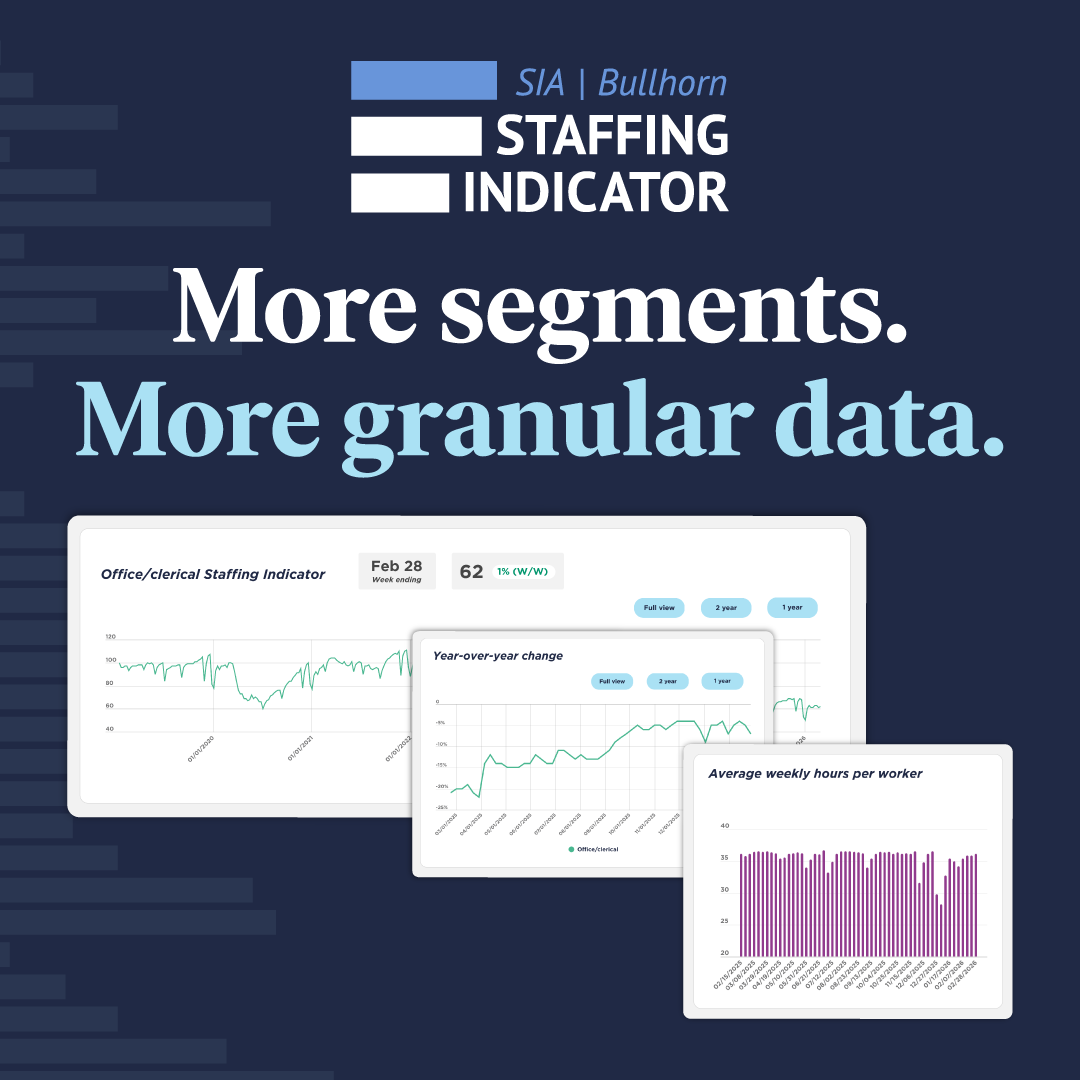
Commercial staffing hours reached a new high for the year and U.S. staffing hours remain at their high point of 2026 for a second consecutive week. U.S. hours are now 1% above the same period last year. We haven’t seen sustained improvement in that year-over-year comparison since September of 2022. Professional hours were largely stable, with a slight week-over-week decline. IT hours remain at their highest top level of the year and are 3% above 2025 levels. Light industrial hours also hit a new peak for 2026 and are outpacing 2025 by 3%. Only office/clerical hours continue to lag year over year, but are showing modest improvement compared to the prior week. Overall, staffing hours have been strong throughout the first quarter of the year.

The SIA | Bullhorn Staffing Indicator has been updated to reflect new occupation-level classification of staffing hours. This shift has been applied to the entire historical data set to keep the trend lines consistent.

SIA | Bullhorn research

US and commercial hours hit year-to-date highs

IT hours reach new high point for 2026

Light industrial hours at highest level of 2026 for third straight week

Office/clerical hours still well below 2025

Staffing Industry Analysts’ perspective

US Staffing hours have remained at their highest level year-to-date for the third consecutive week. Furthermore, US Staffing grew on a Y/Y basis for the first time since September 2022, the most recent prior period of sustained growth. The momentum was driven by Industrial hours and IT hours, both up 3% on a Y/Y basis.

Both Industrial and IT hours remained at their highest level year-to-date, first reached last week. In contrast, Office/Clerical hours continued to show a weaker trend, down 6% from a year ago.

Average weekly hours worked per worker remained unchanged at 35.3 hours, and stable with a year ago. Trends in average weekly hours worked were also stable across our segment-specific measures in industrial, office/clerical, and IT staffing.

We note that the conflict in Iran has yet to show a material negative impact on the US staffing industry, at least as far as we can tell. We will continue to keep an eye out for any impacts in future weeks of data.

Looking ahead, US temporary staffing continues to face headwinds in the form of sluggish growth in the overall US labor market, the conflict with Iran and shock to energy prices, low rates of labor turnover, policy uncertainty, and uncertainty regarding the impact of AI, leading to a cautious approach to hiring from clients. Nevertheless, on the bright side, according to the latest BLS estimates, US temporary help employment grew sequentially in November and January, breaking the pattern of sequential declines that have defined much of the past three years. For more US staffing industry insights, please see our comprehensive US Staffing Industry Forecast: March 2026 Update. For more on the US labor market, please see our US Economic and Labor Market Trends (March 2026) and our March 2026 US Jobs Report.

About the SIA Bullhorn Staffing Industry Indicator

The SIA | Bullhorn Staffing Indicator is a unique tool for gauging near real time weekly trends in the volume of temporary staffing delivered by staffing firms. Each week the Indicator reports data for the week that ended ten days prior to the release. It reflects weekly hours worked by temporary workers across a sample of staffing companies in the US that utilize Bullhorn’s technology solutions. The Indicator is weighted and benchmarked against US Bureau of Labor Statistics data to approximate the composition of the staffing industry by skill. While the indicator does not presume to perfectly reflect the entire universe of staffing firms, it does represent a sizable sample of the staffing industry, reflecting a wide range of occupations, client industry verticals, and geographic footprint that spans the country.

The Indicator can be used by staffing firms to benchmark their past and current performance, as well as a tool for forecasting near term industry trends and outlook.

As the US temporary staffing industry has often functioned as a co-incident indicator for the US labor market and economy, the SIA | Bullhorn Staffing Indicator is also useful for a broader audience of business leaders and investors who are seeking real-time insight.

The Indicator is a joint custom research effort between Bullhorn and industry advisor Staffing Industry Analysts.

Revisions and Technical notes on the SIA | Bullhorn Staffing Indicator 

We note the readings for the last 4 weeks are subject to revision and so should be viewed as preliminary, with the reading for the last recorded week the most likely to be revised in next week’s data release. For further information on how the Indicator has been created and detailed technical notes please refer to the methodology.
Want to stay up to date on US temporary staffing trends?

Subscribe for timely trends, data, and analysis

Join thousands of recruitment pros who subscribe to Bullhorn Insights to receive exclusive trends and data, powered by Bullhorn.

shape of squares